Hello... It's me... I was wondering if after all this time you'd like to start... FILMING!
Yay! I get to start filming after this next post or two!
Today I will discuss my findings with my location search! Now, like my previous research said, I need to find a location that will make my character seem utterly alone and isolated. And due to the fact most Red Rooms are shot in wear house or locked room like places, I went on a search to find the best place to film my opening.
First I thought of my garage at my house because it can facilitate high and low key lighting, the closed space can bring a feel of claustrophobia with no windows, and the look of a mostly empty space with a few items makes it feel like any ordinary garage (which is just what I'm looking for because no Red Room set has ever actually been in a nice, well put together location).
Photos I took:
I want my film, like this scene I will link below from the psychological thriller movie The Eye (2008), to feel very intense with the main focus on the character while there is still commotion and stuff in the background that will entice the audience.
After some further location searching, I found my garage was the perfect place to shoot my film because it was obviously so convent for me, and it provided that tight, industrialized, light/dark space I was eagerly looking for. Also, I don't know any abandoned wear houses nearby and if I did I'd probably be too sketched out to actually go film there being the scaredy-cat that I am (Yes I know... the irony that I'm making a psychological thriller I get it...).
Some props, sticking with the iconography, I want ti utilize for the scene are a vinyl record player. a candle, a chair, a laptop on a stool, and that's it. For lighting, I will be using the yellow natural lighting my garage has from its motion sensor lights that creates a low light feel, and the bright white artificial lighting I have that the garage also offers. With all this in play, all I need to do is find myself an actress!
Welcome my people!
Sorry I haven’t posted recently I’ve been spending some vacation time in LA
(much needed), but I’m back now and ready to continue sharing my journey with
all of you lovelies J
Since I have gone through my
creative process, researched a great amount about horror and psychological
thriller genre conventions, and gone into depth about the surface, deep, and
dark web, it is now time for me to delve into how I want my film opening to go.
I will be making a storyboard and
writing about how I want the plot of my film opening to go. This posting will
be strictly my writing down my intro story.
1.The film opening will begin with a black screen
where the only audible thing the consumer will be able to hear is the sounds of
footsteps and things that would be said on a set like, “We’re live in 10!” or
“Is hair and makeup done?” Something to that extent to make the viewer feel
like they are on a movie set of sorts.
2.The film opening will start with an extreme
close up of a video camera or computer screen camera that will flash on green
as to initiate that it is recording.
3.Then the camera with cut to a mid/wide shot of a
woman sitting strapped in a metal chair in what seems to be a garage or warehouse
type of place, with only artificial light illuminating the room from above.
(I’m still questioning overall the lighting at this point but I am leaning more
towards high key probably for most of the scenes)
4.Then there will be a POV shot from the woman’s
perspective and she’ll look around the room in a bit of a frantic manor (kind
of freaking out), and I want all POV shots to be almost jerky in a way to
create an even more intense feeling of confusion and commotion for the viewer.
I will focus and blur the picture as some points as well possibly.
5.Then the viewer will see close ups of the only
main things I’d like to emphasize in the room, which would be a speaker, a surveillance
camera, a vinyl record player (this is still in question for I hope I can get
approval for a song but at the moment I continue trying to contact labels with
no response, so this prop would be nice to have in my scene but it won’t be
detrimental without)
6.There will be a shot of the woman from the
perspective of someone watching her on a computer screen to reinforce the fact
that she is being broadcasted live.
7.Then, the speaker will briefly explain to her
the situation she sees herself(that
she’s the new star of this Red Room) in and will invite the viewers to
participate and engage with whoever is talking in the speaker over a live group
chat and an area where the viewer can pay for services using digital money
using Bitcoins. Throughout this little speech there will be multiple close ups
of the woman’s face, focus pulls between the girl and the speaker from an OVS
(over the shoulder shot) and the computer video camera, and I’ll include quick
pans or tilts from high and low angels to create a sense of even more chaos and
confusion (sticking with psychological thriller genre conventions).
8.Then after the speaker stops, the girl will
really begin to panic and struggle in her restraints as the camera slowly zooms
out from her and seamlessly transitions to the camera pulling out from another
computer screen where a random person is sitting watching the live-stream of
the Red Room. Then a popup will appear on the person’s screen asking him/her
what fate of the woman they request, and they’ll pick one of then and right
before the person clicks submit the screen will go black to the movie’s title.
I want this film
opening to feel very intense yet very simple yet very intriguing to the viewer
ya know!? Obviously it may be hard to picture how this is going to go over
writing but trust me I have this extreme vision in my mind of mixing almost a SAW movie opening with an intense
psychological thriller horror movie scene from The Strangers (2008) while adding a more digital aspect to it.
(Scene from the movie The Strangers [2008] that really inspired me)
THIS IS GOING TO BE SO COOL! AHHHHH! I’m so excited!
Soon I get to start the really fun
part which will be filming, and I’m very close to getting to that point. Now,
my goal is to go location scouting to find the most appropriate venue for where
to film my opening, and then I need to find an actress who will play the main
protagonist of this scene of the movie. I already have an idea for both of
these next tasks ahead so I will keep all of you guys updated!
It's me, Asher again, ready to delve into more of the unknown as I figure out what I am going to do with this project.
Okay, so to start off, we all understand the current world wide web with browsers like Google and Bing (lets be real no one uses Bing...), you search something and hopefully a desired result is contained within the results. However, would you believe me if I said that you are only barely scratching the surface of what is the WWW? Or the fact that what you see is filtered and monitored by the government or the browser company itself? Well, this is strangely true, for now I will open your eyes to what is known as the deep and dark web (bring a flashlight because you're going to need it).
The Deep Web
Here is an illustration normally used to explain the consciousness vs the subconsciousness but applied to the subject of the deep and dark webs.
The deep web is the second step in this three-part Internet world, located right under the surface web. This area of the Internet is said to contain 90-95% of all the information that cannot be accessed using surface web browsers (by this I mean Google or Bing or a Wiki). Things that would normally be considered classified can be unlocked in this area of the web, and certain downloadable browsers are needed to enter this area. This area is honestly easily accessible with little to no effort, but honestly, for a normal teenager like me, I find no real reason to visit, for there is not much I could accomplish other than reading documents on this area on the web; however, many people are grateful for the deep web due to the fact that it does contain unrestricted access to all the data on the web. People who live in countries like China and Russia, where the government plays a major factor in monitoring their citizens surfing use certain deep web browsers to see what an American may see on a regular day on YouTube or Google without being monitored. To these oppressed people, access to the deep web is a blessing, even if it does come with the risks of being hacked or having information stolen.
The Dark Web Now here comes the scary stuff... The Dark Web! (Dun! Dun! Dunnnnnn!)
Disclaimer: I highly encourage any person reading this blog that is currently not involved with the dark web to stay clear away from it. This is an actual scary place where regular people can get involved and be hurt in the process. I will not include any links to the dark web in this section, for I do not want any person to visit the dark web to be associated with me. You have been warned.
The dark web sounds sinister for a reason, because it's like a dark ally where only the brave, the advised, or the stupid would walk down it. The dark web is mostly encrypted and is known as the 'onion' web (most url's end with .onion or something similar), for people who dare to access this area must use a browser like Tor. With enough persistence, any person could manage to visit the dark web, but it takes a lot more knowledge and effort than just surfing the deep web. The dark web has a lot of drug buying and trading on it, where people can distribute illegally over the Internet with little chance of the government being able to track. The dark web (this is extremely gross and inhumane) contains a lot of pedophilia material in the form of child porn, there is nasty stuff like bestiality videos, and one of the more infamous types of content of the dark web known as 'hurt porn' that portrays children or adults being subject to rape/torture. There is also a large quantity of 'jailbait' porn that features younger teens. (I'd recommend reading about more of this at this link: http://www.smh.com.au/technology/technology-news/the-new-underbelly-20120531-1zktt.html)
The dark web also lets the user the ability to buy and sell weapons (especially guns), buy fake I.D.'s, passports, and even register diplomas.
Now we get even darker... Red Rooms. A Red Room is available live streaming content on the dark web that features the rape, torture, or murder of people (men, woman, children, babies... there are no boundaries). Many say it is impossible to prove a Red Room actually exists or that what is being shown in the video is real or fake, for there have been many hoaxes like one that was supposed to be streaming the torturing of captured ISIS vigilantes (read more about this one here); however, the big mystery about Red Rooms is that since they are impossible to prove if they are real, then they could be just hoaxes or they could be featuring the murdering of real people. Since these sites are so encrypted, people at the FBI struggle greatly to shut these sites down or even find them. The more famous sites on the dark web that may or may not be hoaxes are ones that sell human dolls (stuffed humans), one where people are experimented on (homeless people are abducted and taped being given diseases or having limbs replace), and other Red Rooms that give the consumer the ability to pay in the form of Bitcoins (a digital real currency used on the deep web and even sometimes surface) to have the person portrayed on the Red Room to be tortured to their liking as they enjoy with others in a group chat on the site.
(Image from the human experiment site)
The people consuming these horrible videos and content can be the average person who you would never suspect, which is what has inspired the idea for my film opening. The fact that someone, whether the Red Room was real or not, would pay money to see someone tortured or killed astounds me. I find psychological thrillers more compelling when the story could actually happen in real life (like the movie The Purge). So currently, now that I have researched genre conventions and the subject I want my film to be about, I will begin story boarding and I will show all of you my plot and ideas for my film opening in one of my next postings.
Due to the fact that, through more research, I'm beginning to stray more toward the psychological thriller aspect of my film opening than horror, I will be discussing editing and shots that will aid me in bringing about that genre better.
Types of shots and filming techniques typically used in psychological thrillers as to make a scene more intense and suspenseful:
POV Shots: Used to show character's perspective, especially when in a scary situation. I know this is not a movie, but the viral video game Slender Man became a massive hit due to its extremely scary/suspenseful nature, for the entire game was from a first-person perspective at night where the player was placed in an isolated, dark setting.
High and Low Angles: Used to insinuate that the character is being watched or is in a nightmare of sorts. Nightmare On Elm Street (2010) utilized low angles like the one scene from the bathtub as to infer fear and that the character could not be in current reality. Giving high and low angles at a fast editing rate can also create a triply feeling if fast pans are added to the mix.
Handheld Shots: Used to make the film seem more personal to the character and makes it so that the viewer cannot tell all the time what is going on due to the sometimes blurry movements and shaky image. Cloverfield (2008) was a suspenseful, action-adventure movie that was shot entirely from the perspective on a hand held phone. This made it so that the viewer did not fully comprehend what was going on at every point in the movie, adding to the suspenseful feeling that would resonate with the viewer where they would oftentimes probably be asking, "What just happened... What's going on." (Honestly though, this movie actually made me nauseous because it was filmed in this shaky first-person fashion the entire movie and I felt carsick during it. Unless you can handle intense visuals over a long period of time without feeling queasy, I would not recommend this one.)
Slow editing: When everything becomes slow in a horror movie, the viewer already knows that something horrible is about to happen where the scenes are going to once again become fast paced. Like a jump scare is about to occur or something of that nature. The thriller/mystery movie Prom Night (2008) featured a scene where the main character hid under a bed and the camera would have many close ups on her face as she tried her best to keep her mouth shut as her stalker entered the room. Everything became very quite, and the shots would slowly shift from the character's face to a POV from the character under the bed's view of the stalkers shoes.
Depth of field, focus pulls, and shadowing/blurring the screen are techniques also used often is psychological thrillers as to make the scene more intense, suspenseful, and interment. With psychological thrillers, the main goal is to make the viewer feel like they are in the same terrifying situation as the character portrayed, and through using these camerawork techniques, I should be able do accomplish that swimmingly. (Don't you love that word 'swimmingly...' cause I do)
Hello my good people! I almost totally forgot to make a quick post about how I am currently in the process of getting legal approval from a recording company to utilize one of their songs in my film opening production. The song I wanted to use was "Happy Together" by a band called The Turtles. The overall process was actually pretty easy to figure out how to find and contact the label as to request for the legality to include their song.
I began by simply researching the song, and found a Wikipedia page that listed in a column on the top right side of the page all the necessary information I needed to know about the song, like who was the label that owned it. It stated that the label was one called White Whale. Then by simply researching the label's name on an Internet browser, I stumbled upon their home page and went to the "FAQ" link that was on the home screen. From there, the label website listed the email I needed to get in contact.
Here is a screenshot of the email I sent to White Whale:
In the email, I clearly state how I am going to use the requested song and that I will be making no money off the making of this project (I found that imperative to include in the email). In the email, I included some contact info (I did include my cell number in the actual email but I covered it in white for this blog posting of the photo because I don't want just anybody to be able to have my cell number, I'm more exclusive than that, please...).
I'm not so sure as to how long it will take to receive permission from the label, or if they will even give me permission in the first place, but I guess I'll just have to wait and see.
I was inspired to request for the song "Happy Together" after reading this list of the top ten happy/cheerful songs that have been used in horror movies in order to make a scene feel even more unsettling, ironic, and disturbing. I have to say, I was really considering using "Tiptoe Through The Tulips" by Tiny Tim (used in the horror movie Insidious), but it for some odd reason reminded me too much of some character or song from a childhood show I used to watch called SpongeBob SquarePants, so I stuck with my gut and went with the song by The Turtles.
I will keep you all posted for if/when I am granted approval to use the song. Wish me luck!!!
Main Protagonist (Hero of the story/Person who saves everyone)
Main Antagonist (The villain/monster/killer/etc.)
Stupid teenage or bimbo female character that gets killed at the beginning of the movie
Scary child/children/baby
A police officer is involved somehow
And strictly relating to the psychological thrillers, there is usually a psychopath, emotionally unstable character, or person with a mental disorder
A movie that follows these generic and conventional character types is Final Destination 3 (2006). Look, I'll even show you photos of most of the characters that follow these horror conventions from the movie.
This character is Wendy from the movie, she is the main protagonist (hero) who tries to save her friends from all dying off after a freak roller coaster accident where she lost her beloved boyfriend. What a good person (even though she really didn't need to help all the people from dying, she could've just saved herself and moved on and lived a happy pleasant life but... ya know... then there would be no story...)
Here, in the video link above, are the stupid teenage blond bimbos who are the first to die in any horror movie. They die a horrible death while tanning and drinking slushies(sounds fitting). I'm honestly not sure as to why horror movies always use these characters because the viewer already knows from the start that they're going to die off first. It is just too predictable and I defiantly want to stray from this genre convention.
I have to give it to the movie that the main antagonist is actually pretty original, for it is not the usual villain or monster character. The main antagonist is death itself, like the grim reaper of sorts is killing off each character one by one and taking them as his own. I find this very intriguing because in most horror movies, the main character is usually something that can be fought against, and in this movie the antagonist is something that is impossible to fight because it is not dead or alive... it is just a force of nature in itself. How can a character fight death itself? That is what makes the Final Destination series of movies so compelling in my opinion, for all the characters are fighting something that is nearly impossible to fight, making for a more interesting, less conventional plot.
And then there is the random police officer featured, this one was from Final Destination 2 (2003). Why is a police officer always there as a character in horror related genre films, I guess it is because murders and bad stuff happen so police get involved, but I don't really find it necessary, unless the story has major plans for the character, to include an officer. To me it's just another character that will distract the consumer from the main protagonist and story.
Overall, from todays research I've found that while some aspects of the horror and psychological thriller genre's conventions when it comes to character development are nice, I find that I want my characters to be more unique and less one demential, so instead of including so many characters that will get killed throughout the movie (like all of the Final Destination movies) that the viewer will never be emotionally invested in, I've decided to keep with less characters as to make the fight between the main protagonist and antagonist seem like it has more depth to it. This in return will make the audience feel a stronger connection to the fewer characters I would portray and feel more invested in the plot.
Today is the day I shall venture into discovering all the nooks and crannies that are conventions in horror and psychological thriller genres.
I originally thought that the genres horror and psychological thriller were two completely separate genres all together, however, this is not entirely true because psychological thrillers are actually a subdivision of the horror genre itself. Since the psychological thriller genre falls under the horror genre umbrella, it does utilize many of the well-known horror movie conventions with being a bit more specific to some of its own conventions. I'll explain in the following....
Location/Mise-En-Scene Wise: When a location manager is scouting for a place to film a horror movie, if they are following the genre's typical route, he or she or they would need to find a place that brings about a feeling of isolation. This could be a rural area in the middle of nowhere, ghost town, run down urban city, dark alley or street, or a place that through a person's prior knowledge brings about negative connotation like an asylum or a dark foggy lake. The possibilities are literally endless, but between the two power points, I found that they both highlighted the fact that if a character were placed in whatever setting the location manager chose, it was imperative that the character looked utterly isolated and alone in the setting.
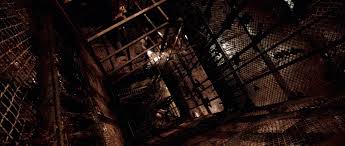
A great example of this genre convention when it comes to location in horror was in the movie Silent Hill (2006). The setting takes place in a different dimension ghost town that during the day is uninhabited and covered with ash, where the main female protagonist of the movie is seen wandering around trying to find her daughter in this desolate, gray space. And when nighttime comes about, the world changes to this hellish-like work where monsters and demonic creatures exist in a dark, industrialized setting that resembles a terrifying labyrinth. Both create a sense of isolation and being alone excellently.
The Daytime World:
Nighttime World:
Also compatible with the horror film shown above, the movie utilizes a color scheme that differs for each of the two worlds, but when the real danger occurs is when the main female protagonist in the movie has to deal with the dark night world, and almost all the colors in that world are black or red in hue. This agrees with both power point presentations with how muted darker colors create a sense through color psychology of danger and fear.
I'm beginning to learn that miss-en-scene is probably one of the most, if not the most, important factor when creating a horror film, for it brings the consumer into that world of fear, and if the setting isn't just right and the color scheme reminds people of happy days, then the fear factor just won't resonate with a targeted audience.
Continuing to relate to mise-en-scene, costume design is a major factor when creating a horror movie, for the main monster or cereal killer or whatever the antagonist may be in a horror movie can become iconic if their costume design is that impactful. Costumes now that are very recognizable from horror are those from the Scream series of movies (the famous mask), the Halloween Mike Myers costume (the famous mask), and The Purge movie series face piece (the famous mask). Wait... are you seeing the same pattern I am? After further research I came to the conclusion that when it comes to a horror genre related film, it's the face or mask that the villain wears that becomes the face of a movie franchise. Every Scream movie has had that famous scream mask featured on its advertising movie poster since the first movie of the brand came out in the late 1990's. Not only have I learned that I need to put a great emphasis on figuring out what face piece I'm going to be using for my main antagonist of my film, but maybe through looking for this face piece I'll be able to create that recognizable brand look to my film that these other successful horror genre related movies have accomplished swimmingly.
Another key factor when relating to horror conventions in films is that during an intense or scary scene, the lighting techniques are quite specific. Low-key lighting, flickering lighting, natural lighting used to barely illuminate a dark area are used quite often to create a sense of suspense and mystery. This is extremely imperative when relating to the psychological thriller aspect of the horror genre as well, as the lighting truly does create a mental state of extreme suspense if utilized correctly.
View this scene from the incredible psychological thriller Shutter Island (2010)
This scene feels intense not only because of the superb acting, but because of the lighting used. The lighting of the match that barley was able to illuminate the space between the two men talking made the scene more intense and personal between the two characters, with the criss-crossed bars scattering the light even more as the lit match seen slowly burns away to a point when the viewer knows it will extinguish and the room will once again become dark. Utilizing genre conventions of a psychological thriller will definitely aid me in creating a scene that is intense, suspenseful, and personal feeling.
Another genre convention the presentations mention is the use of sound techniques like stings and non-diagetic sounds in the background as to aid in the jump scare scenes or to build a sense of fear and danger. An excellent example comes from a scene from the horror movie classic Psycho (1960), specifically the shower scene in the movie. In quick summation, many sharp sounding stings are used in this scene when a woman is shown in the shower being stabbed multiple times. These stings, being accompanied by the quick camera cuts, adds an intense sense of fear that without these non-diagetic sounds would not exist.
Both power points also put a major emphasis on iconography when it comes to props and symbolism (this still relates back to mise-en-scene). When relating to horror movies that have to do with the paranormal and ghosts, oftentimes the viewer sees crucifixes and bibles plastered throughout the scenes of the movie. Here's an image from the movie The Exorcist (1973) that utilizes the typical cross as a prop/symbol in quite the disturbing fashion that relates to iconography:
(The young, possessed girl seen has a cross held in her right hand that she used to impale herself. So that crucifix was used as both a symbol and prop to induce a sense of disgust and intense fear with the audience.)
Other major symbols that could be included in a horror movie that are relevant if the movie isn't a ghost paranormal type are weapons, paintings, candles, dark rooms, etc. These symbols and props, just like lighting, are important in signaling to the viewer that something bad is right about to happen, for when in a horror movie has a consumer seen a candle flicker and not thought to his or herself, "OMG NO THIS ISN'T GOOD!" Through research I'm learning that it is little factors like symbolism, lighting, and props that when combined all together make such an impact in the horror movie genre.
Now that I have a good understanding of mise-en-scene, sound techniques, and iconography when it comes to the horror and psychological thriller genres, all I need to do now is research conventions like editing techniques, typical shots/angles/composition, themes, and character types to have a full understanding of the genre and subgenre I am studying.